Not sure whether you have a Thanksgiving cactus or a Christmas cactus? Discover the key differences in stem shape, flowers, blooming season, and care needs.
Lovely Cactus / Plant identification guide
Thanksgiving Cactus vs. Christmas Cactus: How to Tell Them Apart
You bought a beautiful flowering “Christmas cactus”—but are those pointed, claw-like stems telling a different story? Thanksgiving and Christmas cacti look similar, and garden centers often use their names interchangeably. Fortunately, a close look at the stem segments can usually tell you which one you have.
Quick answer
Thanksgiving cactus (Schlumbergera truncata) usually has sharp, pointed teeth along the edges of its flattened green stem segments. A true Christmas cactus (Schlumbergera × buckleyi) has more rounded, scalloped segment edges and a graceful, arching habit. Both can flower during the winter holiday season, so stem shape is a better first clue than the calendar.
Thanksgiving Cactus vs. Christmas Cactus: Key Differences
Both plants belong to the cactus family, but neither behaves like the classic desert cactus sitting in a hot, dry window. Holiday cacti originate from the moist, forested regions of southeastern Brazil. In nature, many grow as epiphytes, supported by trees rather than rooted in ordinary garden soil.
Thanksgiving Cactus
Schlumbergera truncata
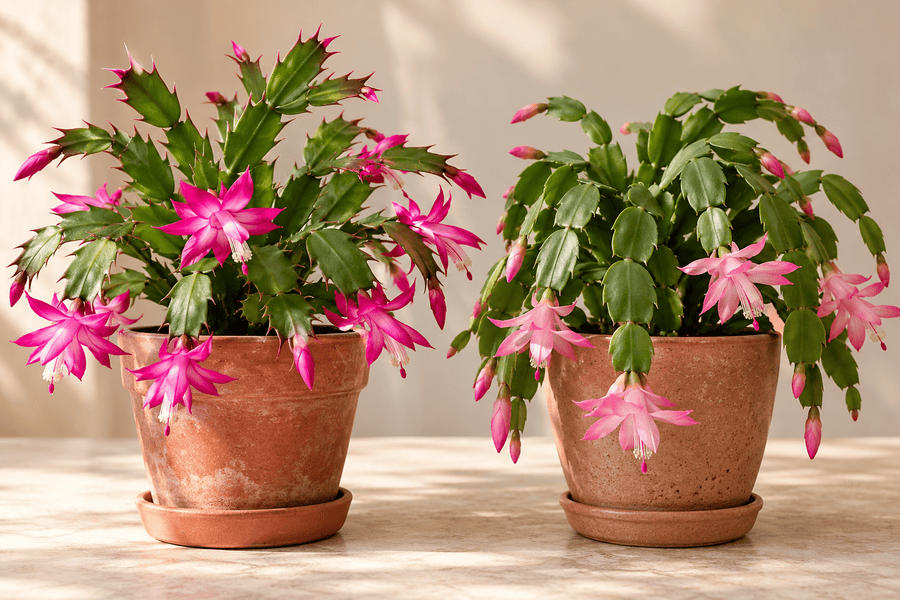
Stem edges: Pointed, tooth-like projections resembling crab claws.
Flowers: Often held outward, with an asymmetrical appearance.
Typical bloom: Late autumn into early winter.
True Christmas Cactus
Schlumbergera × buckleyi
Stem edges: Rounded, gently scalloped margins without sharp teeth.
Flowers: Often more pendulous, carried on arching branches.
Typical bloom: Late autumn through winter, often later.
| Feature | Thanksgiving cactus | Christmas cactus |
|---|---|---|
| Botanical name | S. truncata | S. × buckleyi |
| Stem segment edges | Sharp, claw-shaped teeth | Smooth-looking scallops |
| Growth habit | Often more upright or arching | Typically arching or trailing |
| Flower position | Frequently angled outward | Often hangs downward |
| Blooming period | Often earlier in the holiday season | Often later, with substantial overlap |
These are useful patterns, not absolute rules. Modern hybrids can have intermediate features, and bloom dates change with household temperatures, light, and the cultivar.
How to Identify a Thanksgiving or Christmas Cactus
Step 1: Look closely at the green stem segments
The flat green sections are technically modified stems, even though many gardeners casually call them leaves. Pick a mature, healthy section and examine its outer edges without pulling or breaking it.
A Thanksgiving cactus usually has several noticeable pointed projections on the sides. Some gardeners say the segments look like the claws of a crab, which is why you may hear the name crab cactus. A true Christmas cactus has smoother, rounded, scalloped edges that do not look sharply toothed.
Best identification tip: If your plant is not flowering, stem edges are usually your most practical clue. Check several mature segments rather than judging from a single young tip.
Step 2: Check the growth habit
A mature true Christmas cactus often forms long, gracefully hanging branches. Thanksgiving cacti can also arch or trail, but many have a somewhat more upright appearance, particularly when young. Growth habit is a secondary clue because pot size, pruning, and cultivar can affect the shape.
Step 3: Examine the flowers when they appear
Thanksgiving cactus flowers often have a noticeable asymmetrical form and can project outward from the stem tips. True Christmas cactus flowers tend to hang more freely from arching branches. Both groups may produce flowers in pink, red, and related shades; cultivated selections can offer additional colors.
Flower color alone will not reliably identify your plant. A pink-flowered cactus is not automatically a Christmas cactus, and a red-flowered one is not automatically a Thanksgiving cactus.
Step 4: Use bloom timing only as supporting evidence
Thanksgiving cacti often start blooming earlier, frequently in November in the Northern Hemisphere. True Christmas cacti may flower later, around December and into winter. However, both types can bloom outside their namesake holidays depending on their environment.
The season gives you a hint; the shape of the stem segments gives you stronger evidence.
Why Are So Many Thanksgiving Cacti Sold as Christmas Cacti?
The name “Christmas cactus” is commonly used for several holiday-flowering plants rather than only the true Schlumbergera × buckleyi. Thanksgiving cactus and commercial hybrids are especially common in shops because they can be marketed during the long autumn-to-winter holiday season.
This does not necessarily mean the store sold you an unhealthy or inferior plant. It usually means the retail name is broader than the botanical identity. Both make attractive, long-lived houseplants when cared for appropriately.
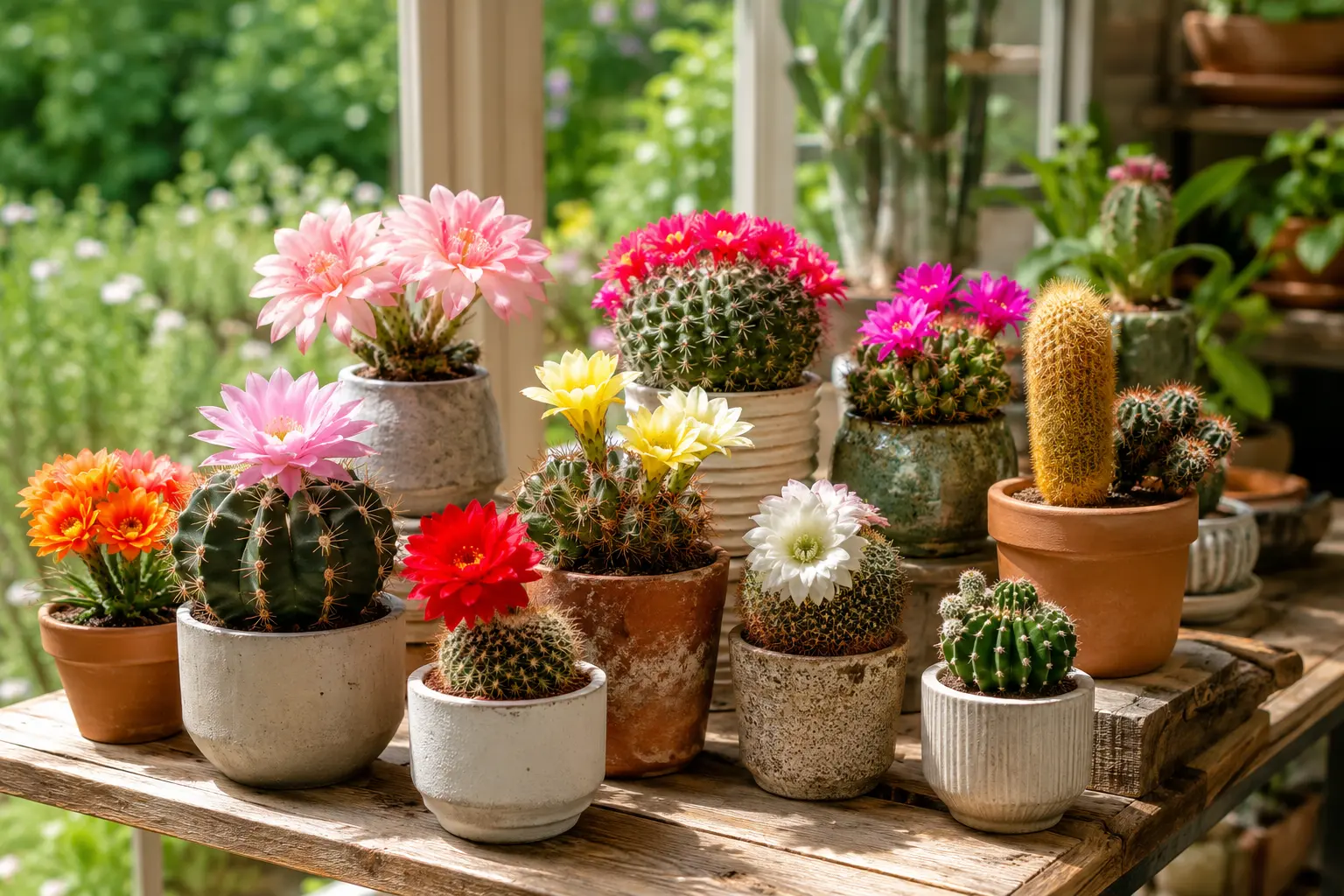
If you are interested in other species that produce flowers indoors, explore our guide to beautiful flowering cactus varieties.
What About Easter Cactus?
There is a third plant frequently mentioned alongside these two: the Easter cactus, commonly known as Rhipsalidopsis gaertneri (also found under other botanical classifications). Its stem segments generally have rounded margins, and its flowers are often more star-shaped than those of Thanksgiving and Christmas cacti.
Easter cacti typically bloom in spring in the Northern Hemisphere, although growing conditions influence their schedule. That spring flowering period can help distinguish them, but again, examine both stems and flowers.
Three holiday cacti in one sentence
Thanksgiving cactus = pointed, claw-like edges; true Christmas cactus = gently scalloped edges; Easter cactus = rounded edges with a different, often starrier flower shape.
How to Care for Thanksgiving and Christmas Cacti Indoors
The good news is that the two types have broadly similar care requirements. They are forest cacti, not sun-baked desert species, so they appreciate bright filtered light, an airy potting mix, and more regular moisture during active growth than many desert cacti do.
Light: bright but filtered is usually best
Place your holiday cactus near a bright window where it receives plenty of indirect sunlight. Gentle morning sunlight may be suitable, but intense afternoon sun can scorch the flattened stems, particularly if the plant has been growing in shade.
An east-facing window can be a useful starting place in many Northern Hemisphere homes. Adjust according to the actual brightness and temperature in your room. For a broader explanation of window exposure, read how much sunlight a cactus needs—keeping in mind that holiday cacti are different from desert cacti.
Watering: do not treat them like desert cacti
During active growth, check the soil regularly. Water thoroughly when the upper portion of the mix begins to dry, then let the excess drain away. Avoid letting the pot remain waterlogged, but do not deliberately keep a healthy holiday cactus bone-dry for long periods as you might with certain desert species.
There is no universal weekly schedule. A plant in a small, warm pot may dry much faster than one in a cool room. Our cactus watering guide explains how potting mix, weather, and drainage influence moisture; always adapt those principles to your specific cactus type.
Soil: choose a breathable, well-draining mix
Holiday cacti need a mix that holds some moisture without staying soggy. A suitable houseplant mix amended with perlite or another airy material can work well. Because these are forest cacti, they generally appreciate more organic matter than many desert cacti.
Avoid compact garden soil in a container. If you want to understand drainage ingredients and how to assess a mix, see our cactus soil guide, while remembering that its desert-cactus recipes may need adjustment for holiday cacti.
Pots: drainage matters more than decoration
Choose a container with at least one drainage hole. Terracotta, ceramic, and plastic are all usable, but pot material affects how quickly the mix dries. A pot only slightly larger than the root system is usually easier to manage than an oversized container.
If you use a decorative cover pot, take the plant out to water it and allow it to drain before returning it. Our guide to the best pots for cactus and succulents helps you compare the materials.
Temperature and humidity: aim for steady conditions
Holiday cacti generally do well in comfortable indoor conditions. They benefit from avoiding cold drafts, hot heating vents, and abrupt environmental changes. Moderate household humidity is often adequate, although excessively dry air can contribute to stress and bud problems.
When buds are forming, cooler nights can help encourage flowering. Once a plant has developed buds, try to maintain reasonably stable light, temperature, and moisture rather than repeatedly moving it between very different rooms.
Fertilizer and repotting: keep it simple
A balanced houseplant fertilizer used according to its label during the growing season can support healthy growth. Feeding is generally reduced or paused during the late-season rest period. Avoid adding extra fertilizer to force blooms; light and temperature are more important signals.
Healthy holiday cacti often do not need annual repotting. If the roots are crowded or the growing medium has broken down, repot into a slightly larger container with fresh, airy mix. For general handling principles, see how to repot a cactus safely.
How to Help a Holiday Cactus Bloom
Thanksgiving and Christmas cacti respond to the changing seasons. Shorter days, longer uninterrupted nights, and cooler temperatures help initiate flower buds. They do not require the same extremely dry winter care sometimes recommended for desert cacti.
01 / Give the plant long nights
During fall, let the cactus experience a reliable day-and-night cycle. Bright lamps at night can interfere with the seasonal signal.
02 / Encourage cooler evenings
Mildly cooler nights can encourage buds. Avoid freezing conditions and sudden temperature extremes.
03 / Keep care consistent
Provide appropriate light and careful moisture. Once buds form, avoid sharp changes in warmth, humidity, or watering.
In suitable conditions, many holiday cacti respond after roughly six weeks of shorter days and/or cool nights. Exact results vary by cultivar and household. A cactus kept in a brightly lit room every evening may have difficulty receiving the uninterrupted nighttime period it needs.
If the plant looks healthy but fails to flower, do not immediately add water or fertilizer. First check its seasonal light and temperature. Read why your cactus is not flowering and our indoor cactus blooming guide for related troubleshooting advice. Those general articles cover multiple cactus types, so match the advice to a forest holiday cactus.
Why are the flower buds falling off?
Bud drop can follow sudden changes in temperature, moisture, humidity, or light. Check for standing water, overly dry mix, or a heater blowing toward the plant. An occasional dropped bud is not always evidence of a serious problem.
Can You Propagate Thanksgiving and Christmas Cacti?
Yes. Both are commonly grown from stem-segment cuttings, making them suitable plants to share with family or friends. Healthy pieces with a few joined segments can develop roots in an airy rooting medium when kept in bright, indirect light and cared for gently.
For a straightforward approach, take a healthy section with a few segments, let the cut end dry briefly, and place the base in a lightly moist, free-draining rooting medium. Avoid keeping the medium saturated. Rooting takes time, and new cuttings should not be placed in harsh direct sun.
See our full guide to propagating cactus from cuttings. For the most precise holiday-cactus technique, the Iowa State Extension propagation instructions describe the method for Christmas cactus specifically.
Common Thanksgiving and Christmas Cactus Problems
Shriveled or wrinkled stems
Shriveling may mean the plant is too dry, but roots damaged by prolonged wet soil can also prevent it from absorbing water. Check the mix and root condition before watering again. Our article on wrinkled cactus stems explains why appearance alone may not identify the cause.
Soft sections and constantly wet soil
Poor drainage can lead to root or stem damage. Empty standing water, check the potting medium, and examine the roots if there is a persistent musty smell or widespread softness. Read how to identify and treat cactus root rot for a fuller diagnosis.
Cottony white patches
Cottony white clusters around stem joints may be mealybugs. Isolate the affected plant from other houseplants and confirm the pest before choosing a suitable treatment. Our mealybug identification and treatment guide can help.
Lots of new growth but no flowers
If stems look healthy but buds never form, evaluate the fall light cycle and nighttime temperature. Regular room lighting late into the evening can be enough to interrupt long nights. A plant that is still immature or recovering from stress may also need more time.
A Simple Holiday Cactus Care Checklist
- Check several mature stem segments to help identify your type.
- Provide bright, filtered light and protect from harsh midday sun.
- Use an airy potting medium and a pot with drainage holes.
- Water when the upper mix begins to dry; never leave water standing beneath the pot.
- Avoid sudden temperature and light changes, especially when flower buds are present.
- Allow naturally longer nights in autumn if you want holiday blooms.
- Inspect stem joints occasionally for pests or signs of root stress.
Frequently Asked Questions
Is a Thanksgiving cactus the same as a Christmas cactus?
No. They are closely related holiday cacti, but the classic Thanksgiving cactus is Schlumbergera truncata, while the true Christmas cactus is the hybrid Schlumbergera × buckleyi. Their stem segment edges are often the clearest visual difference.
How do I tell the difference without flowers?
Look at the flat green stem segments. Thanksgiving cactus generally has sharp points along the margins, while a true Christmas cactus has rounded, scalloped edges. Modern hybrids can look intermediate.
Why does my Christmas cactus bloom in November?
It may actually be a Thanksgiving cactus or a hybrid sold under the broader Christmas cactus name. Also, bloom dates are affected by night length and temperature, so timing is not proof on its own.
Do Thanksgiving and Christmas cacti need direct sunlight?
They generally prefer bright, filtered light. Some gentle sun may be fine, but harsh afternoon exposure can damage plants that are not acclimated to it. They have different light preferences from many desert cacti.
Should I let holiday cactus soil dry completely between waterings?
Not necessarily. During active growth, holiday cacti generally appreciate more regular moisture than many desert species. Let the upper mix start to dry, then water and allow thorough drainage rather than keeping the entire pot soggy or excessively dry.
Can a holiday cactus bloom more than once?
Some plants may produce additional blooms when conditions trigger buds again, but the main flowering season typically corresponds to shorter days and cooler conditions. Do not expect a fixed number of bloom cycles.
What is the difference between an Easter cactus and a Christmas cactus?
Easter cacti often have rounded stem segment margins and more star-shaped flowers, with a typical spring blooming period. True Christmas cacti have scalloped stem edges and generally flower during the cooler holiday season.
Final Thoughts
The easiest way to settle the Thanksgiving cactus vs. Christmas cactus question is to examine the green stem segments. Pointed, crab-claw-like edges suggest Thanksgiving cactus, while soft, rounded scallops suggest a true Christmas cactus. Flowers and blooming dates can support your answer, but hybrid plants make those signs less certain.
Whichever type you own, focus on its forest-cactus needs: bright filtered light, a draining pot, a breathable growing medium, and thoughtful watering. With consistent care and the right seasonal light cues, both can reward you with colorful flowers for years.
For a wider foundation, explore our complete indoor cactus care guide, then adjust your routine for the specific holiday cactus you have.